
Inspiring and transforming through leadership and knowledge of sustainability
To inspire others while being effective and relevant in the 21st Century, we need to cultivate both our leadership as well as learning the hard skills of sustainability.
Among the inspiring people who spoke at the conference, Fabrice Bonnifet shared with his usual passion and deep conviction that business leaders are playing a game with obsolete rules. Indeed, as sociobiologist Edward O. Wilson said, “Humanity is Paleolithic Emotions, Medieval Institutions, and Godlike Technology.”
He emphasized the need to reinvent our business models in depth, instead of a mere “greening” the products and services we create.
For example, the industrial production is obsolete, especially to nourish ourselves. The true source of prosperity is the thriving of living systems.
Principles of Regenerative businesses and economy
Life creates the conditions for life.
There is no sustainability without the regeneration of resources.
Regenerative businesses need to be profitable if they want to replace the current linear business models.
We need to shift from a pyramidal economy to a network-based economy where players co-evolve.
We need to shift to an economy of functionality and cooperation.
A concrete example from Colombia where a region has been protected against further extraction of rare earth metals, and where the production of coffee with regenerative agriculture has been developed instead.
“Only action will liberate us from death.”
“When it will be desperate, I will teach you to want.”
“You need to stop hoping and start wanting instead.”
The world is transformed and created by engineers. Engineers need to be retrained with new paradigms of thinking and feeling.
I would add the same about business people, and people in the spheres of politics.
In fact the world is co-created by all of us. Most of us need to be (re-)educated for more emotional intelligence, connection and deep understanding and care for all living beings, as well as the development of our full potential and wisdom.
Fabrice Bonnifet has announced the launch of GenAct, a platform for all those interested in participating in the social and environmental transition that is taking place. It will be launched to the public on the 26th of April this year at the World Expo for Solutions for the Planet by ChangeNOW in Paris.
Here are some of his 10 commandments of the regenerative paradigm, which I find deeply meaningful:
- Transparency towards the consumer, including where the money of the consumer goes (% of profit margin, % to reward the investors, …)
- 1+1=3 : the importance of symbiosis and understanding “frugal abundance”
- Adding representatives of the Living World in board meetings with a veto right (so far, despite the top-management identifying environmental risks in the top risks for organizations, they are not taken into account sufficiently in strategies which aim mainly at satisfying the desire of investors for higher ROIs).
- Shift management systems from pyramidal/top-down to more participatory, like Frédéric Laloux proposes in Reinventing Organizations
- Shift towards multi-capital accounting: human capital, natural capital, financial capital, …
- Experiment with more bottom-up approaches
Doughnut Economics
I was glad to attend the talk by Kate Raworth and Mathis Wackernagel.
Kate Raworth presented the Doughnut Economics model, which integrates the Planetary Boundaries as well as the social foundations laid out by the UN Sustainable Development Goals:

Kate Raworth reminded us that the top 1% of people on this planet owns 50% of the world’s wealth.
(By the way, if you earn more than $124,720 per year, you are earning more money than 99% of the world population.)
To survive as a species and a civilization, we need to learn to enjoy sobriety, frugality and sufficiency. It can be a joyful and fulfilling evolution of our lifestyles, economies and consumption patterns.
2050 is tomorrow.
Paul Watson in person
It was an honor and a pleasure to see Captain Paul Watson in person.
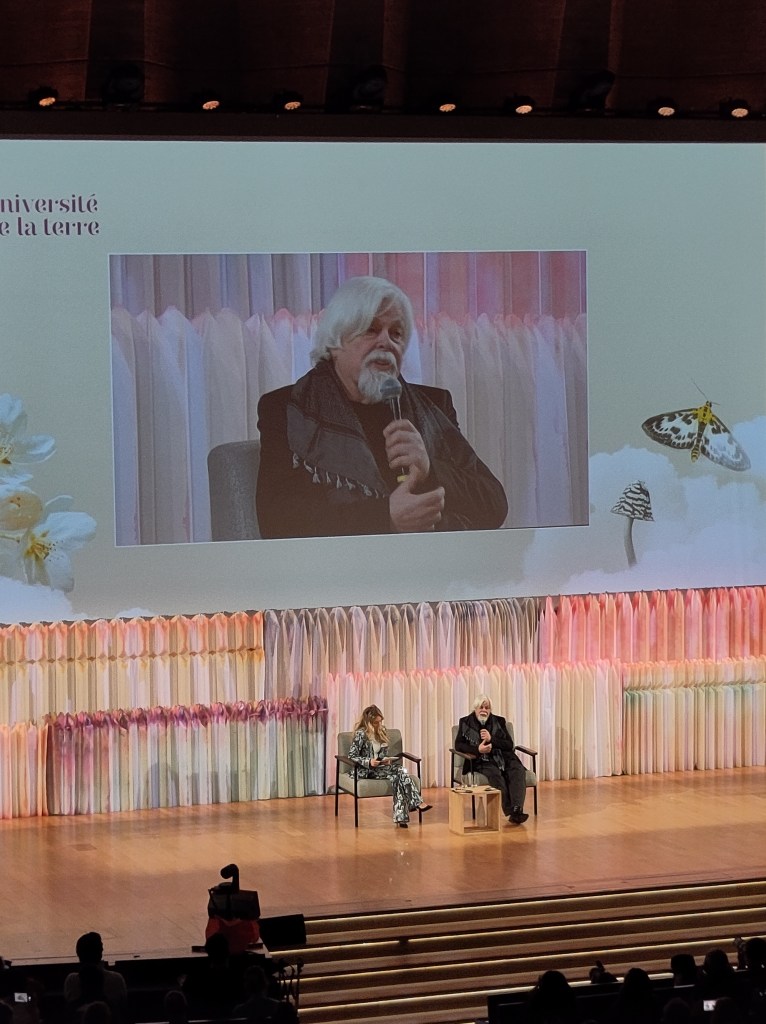
During his interview/talk, he owned his story of “being a pirate” and navigating a fine line to combine activism and pragmatism. He shared his tactics to expose the systemic violence exerted by commercial activities against the biosphere, leveraging on the mass media’s appetite for scandals and violence, and rallying celebrities to the cause to raise the awareness of the mainstream public.
Inspiration from deep thinkers
I felt inspired by the talk by Jean-Pierre Goux, author, mathematician, entrepreneur and founder of the OneHome NGO aiming at sharing the Overview effect with all.

This was a profound experience of connection and depth.
To get a glimpse of this effect, get quiet, close any distractions, and watch:
He explained that China had a strong long-term vision, but was dictatorial on the short term. The country’s strength lies in the unity it managed to foster, but lacks the integration of its diversity.
On the opposite site of the geopolitical spectrum, the U.S. tapped into its formidable diversity, but lacks a sense of unity. I heard elsewhere the nickname of the “Divided States of America”. The latest presidential election might bring changes to the integration of diversity, but the future only will tell…
He shared his aspiration for our species Homo Sapiens to transition towards Homo Biospheris.
Corine Pelluchon shared in a roundtable that nationalism is a form of collective narcissism. Modern people have the choice between being resentful or being grateful, like Hannah Arendt said in her time. What we cannot see in the world are the relationships between living beings, which constitute the web of living beings. Maybe the unconscious will save us… That would make sense, since virtually all of our information processing happens at an unconscious level (the unconscious processes around 11 million pieces of information per second, compared to the 40 pieces of information per second for our conscious mind).[1]
She reminded us that we need to think in terms of “foods” rather than “resources”. Foods nourish us, not only physically, but also emotionally, aesthetically, … They literally give savour to life. They also tell us about who we are, and which place we give to other living beings in life.
She exposed the hypocrisy of our western society living in a “culture of death” which lives in denial of our own mortality, while feeding off the death of so many other living animals.
She reminded us that humans have radical Evil embedded within them, but have a predisposition towards to do Good, as Immanuel Kant said. Most human beings are doing good in the world, although most people are fascinated by the darkness, promoted by the media to sell.
“Earth does not need to be saved, she needs to be loved.”

Matthieu Ricard, whose writings and philosophy I have enjoyed for over a decade now, emphasized the need for countries to develop qualitatively rather than quantitatively. For instance, Bhutan, which created the Gross National Happiness index, chose to enshrine in its constitution a guarantee to maintain at least 60% of its forest cover, even though exploiting this forest could have generated 25 times the GDP of the country… In my view, it will take a tremendous evolution of psychological maturity and probably spiritual dedication for most political leaders to come to such commitments…
Matthieu Ricard also explained the challenge for humanity to reconcile three temporal horizons:
The short term: our survival, say for a week, since most humans still live in precarious conditions on earth
The mid-term: over the course of a career, a life, or a family’s life
The long-term: the destiny of millions of generations to come.
If you think about it, around 120 billion homo sapiens have existed already, and according to researchers, humanity, if it survives, could engender 1016 human descendants with “normal lives” in the future.[2]
[1] https://neuroinsights.in/2020/07/12/conscious-and-unconscious-thought-processes/
[2] Bostrom, N. (2013). Existential risk prevention as global priority. Global Policy, 4(1), 15-31.
[Part 2] to come out soon.
 Jean-Sébastien Simon - Conscious Business Coach