
Image by Multimedios Del Sureste from Pixabay
One of the models I share the most with participants in my leadership and communication trainings is the 3 circles of responsibility model. It can be helpful in both your professional relationships as well as in your personal ones.
We can so easily get caught up in our stories, and in trying to control things that are out of control, that we waste a lot of our time and energy doing so, leaving little left to focus on moving forward and taking care of ourselves and our priorities.
Take the example of Karen, a manager who has to make sure that her team stays on track. Karen feels a bit worried.
She just got promoted and is still learning the ropes of being a manager. Sometimes, when she meets Augustin, her boss, she feels a bit afraid that she is not doing enough and not doing well enough. During some of their 1:1 meetings, she notices Augustin raising his eyebrows, checking his phone, and looking frustrated. When that happens, Karen tends to feel a bit nervous, and tries to expedite the meeting to avoid the discomfort. She then questions herself and her abilities as a manager.
Karen got an appointment with her coach to discuss and process the situation.
Insights from coaching
First of all, her coach pointed to her way of reacting when she feels uncomfortable: She tends to withdraw, and her breath becomes shallower. Her coach suggested that she “breathes deeply into the discomfort”, counting three slow breaths from the belly. He gave her an exercise to practice:
Sit or stand comfortably and simply put one or two hands on your belly. Breathe deeply so that you feel your belly growing as you inhale, and breathe out slowly as you feel your belly empty the air from your lungs. Do this ten times slowly, five days a week for 3 weeks.
That helps to reset the nervous system and tune it into being present rather than a fight or flight response in any uncertain or tense situation.
Later in the conversation, following a few questions by her coach, Karen, noticed something she had not thought about:
She was actually making assumptions in her mind, namely that Augustin is not satisfied with her work, or that he is feeling frustrated because of her. Her coach asked her whether she checked-in on her assumption with Augustin.
She replied clearly with the negative.
Her coach pointed out another way of behaving. She could say:
“Augustin, I am noticing that you are raising your eyebrows and fidgeting with your phone during our meeting. I’m not sure how you feel and what you need the most right now, and I am feeling a bit nervous and scared.”
That would give space to Augustin to respond.
Maybe Augustin is worried about his Executive Committee meeting coming up in an hour, or maybe he is dissatisfied with Karen’s performance. The best way to find out is to check-in on assumptions.
The second thing Karen got from her coaching session was that she was actually placing too much of her attention on her bosses’s business.
Her coach reminded her:
“Your boss is allowed to feel angry and frustrated. You don’t have to change that. What if you could keep your composure no matter how other people around you felt and behaved?”
That was another insight for Karen.
If she dived deeper with her coach, or with her therapist, she might find out that she developed this behavior as a child to try to not upset one of her parents, who was – at the time – the source of her love and approval.
These patterns stay ingrained in us into adulthood and we often tend to reproduce them unconsciously with other people, especially authority figures, unless we do the work and rewire our way of thinking and relating to others and to oneself.
The 3 circles of responsibility model
Karen’s coach showed her a model to help her discern relational situations better. I learned it from Byron Katie, and is called “Circles of Reponsibility”:
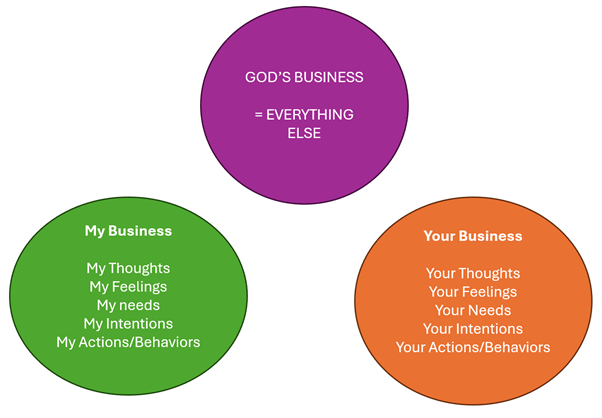
The first circle is “My business”, it is all the things I can have a strong influence on. (Some might say “control”, but I don’t believe we should control everything. We can aim for understanding, or even mastery, but trying to control what we feel and how we act might not be the healthiest way of expressing our being in the world.)
In my circle of responsibility, which is “my business”, I can be aware of and set specific intentions, be aware of my feelings, my needs and my thoughts, as well as engage in actions and behaviors. I can take 100% responsibility for that.
However, there is also the second circle of responsibility, the other person’s business: the other person’s intentions, feelings, thoughts and needs as well as actions. I have 0 control over that, and can merely try to influence it. At this stage of my understanding of leadership and management, I don’t believe in the necessity to influence other people’s behavior although classic leadership and management literature and trainings do lean in that direction. I do believe however, in leaving each person with their free will to decide, and to model the best we can as leaders, while empowering and supporting others who want to grow and evolve. Also, when necessary, letting go of the people who do not have the intrinsic motivation to do so, and who do need to be coaxed or manipulated to move forward.
The third circle of responsibility is “God’s business” (you can call it Spirit, The Divine, The Universe, Life, whatever you want). Basically, it is everything else.
Worker unions organize a major strike? God’s business. You have very little control over it (although you might try to influence the outcome one way or another).
Global warming? God’s business. (You can however focus on what is in your circle of responsibility to not contribute further to the problem, or even reverse it).
Major geopolitical crisis? God’s business. Focus on what you can do: how can you stay safe, protect your loved ones, or help out in any way to restore the peace depending on your capacity and influence.
By placing your “locus of control” – as they say in management literature – back in your business, you will regain tremendous energy, focus and momentum.
No need to listen or feel influenced by naysayers and critics. You can take insights from their words, but not take things personally.
How about you, what are 1-2 areas of your life where you could refocus on Your business?
How would you feel if you did that?
What would that allow you to accomplish?
 Jean-Sébastien Simon - Conscious Business Coach